
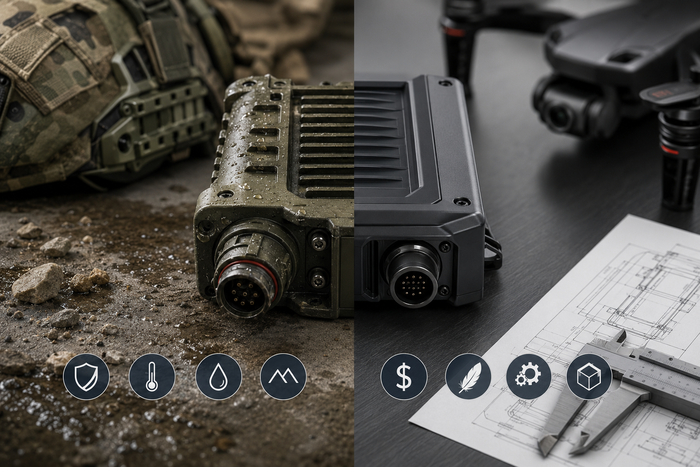
Military and commercial products can look nearly identical on paper same computing platform, similar form factor, comparable performance specs. What separates them is how each is engineered to survive its operating environment. This article breaks down exactly what “military-grade” means in practice, where the engineering trade-offs show up, and how those decisions play out in dual-use product design.
Military-grade vs. commercial-grade engineering
Military and commercial products often perform similar functions, but they are engineered for very different operating environments. While commercial systems are designed for controlled conditions such as offices, factories, and laboratories, defense systems must continue operating in the presence of vibration, shock, temperature extremes, moisture, dust, and electromagnetic interference.
These environmental demands influence nearly every engineering decision. Component selection, enclosure design, thermal management, electrical architecture, and system validation must all be considered to ensure reliable performance throughout the product’s operational lifecycle.
These trade-offs aren’t theoretical. An unmanned aerial system has to shed every unnecessary gram while still surviving vibration and thermal swings in flight. An unmanned ground vehicle needs the same shock and vibration tolerance, but now has weight and power budgets to work with instead of aerodynamics. An unmanned surface vessel trades weight concerns for sealing and corrosion resistance against sustained marine exposure. Same underlying question, commercial or military-grade, three very different answers.
The comparison below illustrates this difference. Although both systems are built around similar computing technologies, military-grade platforms incorporate ruggedized mechanical designs, sealed interfaces, and enhanced environmental protection to support mission-critical applications where reliability cannot be compromised.
Commercial-Grade
- Cost optimization
- Consumer usability
- High-volume production
- Controlled operating environments
- Shorter product lifecycles
Engineering Overlap
- Systems Engineering
- Mechanical Design
- Electrical Engineering
- Embedded Software
- Prototyping & Testing
- Design for Manufacturing
Military-Grade
- Harsh-environment operation
- Shock and vibration resistance
- EMI/EMC protection
- Mission-critical reliability
- Extended lifecycle support
What makes a system military grade?
Military-grade systems are engineered to maintain reliable performance under conditions that would quickly degrade or disable conventional commercial electronics. Rather than focusing on a single feature or component, military-grade design considers the complete system and how it will perform throughout its operational life.
Engineers must account for environmental exposure, mechanical stress, electromagnetic compatibility, long-term reliability, and maintainability from the earliest stages of development. These requirements influence everything from enclosure materials and connector selection to circuit board design, thermal management, and manufacturing processes.
Military systems are commonly designed and validated against established standards to demonstrate their ability to withstand harsh operating environments. While the exact requirements vary by application, several engineering principles remain consistent across most defense programs.
Defense product development process
These environmental and reliability differences must be accounted for throughout the full development lifecycle, from requirements definition through prototyping and verification. For the complete process, see Defense Product Development.
Engineering challenges in defense product development
Defense systems operate in environments where mechanical stress, harsh weather, and electromagnetic interference are everyday conditions. These challenges require engineering decisions that prioritize reliability, durability, and consistent performance throughout the product lifecycle.
Successfully developing a defense system means addressing multiple engineering disciplines simultaneously. Mechanical, electrical, embedded, and manufacturing teams must work together to ensure the final product can withstand demanding operational environments without compromising performance.
Core engineering challenges include:
- Shock & Vibration – Designing systems that withstand repeated impacts, continuous vibration, and transportation loads.
- Thermal Management – Maintaining reliable operation across extreme hot and cold environments.
- EMI / EMC – Preventing electromagnetic interference while ensuring compatibility with nearby electronic systems.
- Environmental Protection – Protecting electronics from moisture, dust, corrosion, and contaminant ingress.
- Size, Weight & Power (SWaP) – Balancing performance with strict space, weight, and power constraints.
- Long-Term Reliability – Engineering products for extended service life with minimal maintenance and maximum uptime.
Engineering considerations for successful defense programs
Developing products for defense applications requires balancing technical performance with long-term reliability, manufacturability, and program objectives. Decisions made early in development influence qualification testing, production readiness, lifecycle costs, and overall mission success. Successful programs integrate these considerations throughout the engineering process rather than addressing them individually.
Reliability by design
Reliability under harsh conditions isn’t achieved after the fact, it’s built in through architecture selection, component specification, and system integration decisions made early, specifically because commercial-grade parts and processes won’t hold up under military operating conditions.
Core design principles
Designing for defense applications requires more than selecting rugged components. Engineers must consider reliability, maintainability, environmental protection, and system integration from the earliest stages of development. By incorporating these principles early, teams can reduce technical risk, improve product performance, and streamline qualification testing.
Maintainability and lifecycle planning
Military-grade systems are often expected to remain operational for many years, making long-term support an important engineering consideration from the beginning of development. Designing with maintainability in mind includes selecting components with stable availability, simplifying service and replacement procedures, and planning for future upgrades or technology refreshes. By considering lifecycle requirements early, engineering teams can improve long-term system reliability while reducing operational disruptions and costly redesigns as products evolve.
Common military standards
Defense products are developed and evaluated against established standards that define how systems should perform in demanding operational environments. While each program has unique requirements, the standards below represent some of the most commonly referenced benchmarks for environmental durability, electromagnetic compatibility, quality, and overall system reliability throughout the product development process.
| Standard | Primary Focus | Purpose |
|---|---|---|
| MIL-STD-810 | Environmental Testing | Evaluates equipment performance under vibration, shock, temperature, humidity, altitude, dust, sand, rain, and other environmental conditions. |
| MIL-STD-461 | EMI / EMC | Defines electromagnetic emissions and susceptibility requirements to help systems operate reliably without causing or receiving interference. |
| MIL-DTL-38999 | Electrical Connectors | Specifies rugged circular connectors for harsh environments requiring secure, sealed, and reliable electrical connections. |
| IP67 / IP68 | Ingress Protection | Defines enclosure resistance to dust intrusion and temporary or continuous water exposure. |
| IPC Class 3 | Electronics Assembly | Establishes workmanship requirements for high-reliability electronic assemblies used in mission-critical applications. |
| AS9100 | Quality Management | Defines aerospace and defense quality-management requirements related to consistency, traceability, risk management, and controlled production. |
Defense applications
Bringing defense products from concept to deployment
Selecting the best path forward
The specific steps of concept development can vary depending on the context and the goals of your development effort for instance if you are looking for a rapid product development process, but the steps we have laid out above are a good starting place. Remember to approach the concept development process systematically, thinking critically, and relying on research and analysis. If done correctly, you will have two to three generated, vetted, and down-selected concepts ready for prototype development.
Generate Better Concepts!
We’ve created a free workbook teaching you how to generate concepts that fit your product development needs.