Food and beverage equipment has to be designed around more than how the machine operates. Surfaces may come into direct contact with food, cleaning chemicals, water, oils, and other substances throughout normal use. Equipment may also be cleaned repeatedly over its service life, placing additional demands on materials, seals, enclosures, joints, and electrical components.
These conditions need to be considered during product development. Material selection, equipment geometry, ingress protection, and cleaning requirements can all influence how easily equipment can be maintained and how well sensitive components remain protected.
Why food equipment requires a different design approach
Equipment used around food has operating requirements that may not apply to conventional industrial or consumer products. A component that performs well mechanically may still be a poor choice if it is difficult to clean, traps residue, absorbs moisture, or degrades after repeated exposure to cleaning chemicals. The design therefore has to account for both normal operation and what happens when the equipment is cleaned and maintained.
The same applies to the overall equipment design. Gaps, seams, fasteners, internal corners, and poorly positioned components can create areas that are difficult to reach during cleaning. These individual details can influence how easily the equipment can be cleaned throughout repeated use.
Common design considerations include:
- Food-contact surfaces – Materials and surfaces that directly contact food need to be appropriate for the intended application and cleaning process.
- Material compatibility – Metals, plastics, coatings, adhesives, and elastomers need to tolerate the substances and chemicals they will encounter.
- Surface finish and geometry – Equipment geometry can either reduce or create areas where food residue, liquids, and contaminants collect.
- Water and contaminant ingress – Enclosures and sensitive components may require protection from water, food particles, and other contaminants.
- Seals and gaskets – Sealing interfaces need to remain effective during repeated operation, cleaning, and maintenance.
- Repeated washdown – Water pressure, temperature, and cleaning frequency can influence enclosure and component requirements.
- Drainage and moisture management – Equipment should allow water and other liquids to move away rather than remain trapped after cleaning.
These considerations are closely related. Material selection, for example, cannot completely solve a cleanability problem if the equipment geometry still creates inaccessible areas where residue or water can collect.
Material selection for food equipment
Material selection affects durability, cleanability, corrosion resistance, and how individual components perform after repeated exposure to food and cleaning processes. Stainless steel is commonly used in food equipment because of its corrosion resistance and ability to withstand repeated cleaning. Depending on the application, food-grade polymers, elastomers, coatings, and other materials may also be appropriate.
The important consideration is how the selected material will behave in its actual environment. Engineers need to consider the substances it contacts, how frequently it is cleaned, the cleaning chemicals being used, and whether moisture will regularly be present. This makes material selection closely connected to the cleaning process and overall equipment design.
Designing to reduce areas where residue can collect
Cleanability is influenced by the geometry of the equipment itself. Deep seams, sharp internal corners, exposed threads, overlapping panels, and inaccessible spaces can make equipment more difficult to clean. Horizontal surfaces may also allow water or food residue to remain in place instead of draining away.
Design teams can reduce these issues by considering cleaning access while the enclosure and mechanical architecture are still being developed. Addressing these details early gives engineers more flexibility than attempting to correct them after major components and interfaces have already been established.
This may include:
- Minimizing unnecessary seams and gaps to reduce locations where food, liquids, and cleaning residue can accumulate.
- Providing access to components that require regular cleaning so routine sanitation does not require unnecessary disassembly.
- Avoiding unnecessary exposed fasteners in food-contact areas where threads and recesses can make cleaning more difficult.
- Designing surfaces to support drainage rather than allowing water or residue to remain after cleaning.
- Making removable components easy to disassemble and reinstall when those components require frequent cleaning or inspection.
Engineering considerations within food safety designs
Food-contact surfaces
Materials used where food is prepared, processed, dispensed, or stored should be appropriate for the intended contact conditions. Engineers also need to consider how surface texture, joints, and component geometry affect cleaning. Smooth, accessible surfaces generally make it easier to remove residue than rough surfaces or assemblies containing unnecessary gaps and recesses.
Chemical compatibility
Cleaning and sanitizing agents can affect plastics, coatings, adhesives, seals, and other materials differently. Repeated exposure can lead to swelling, cracking, discoloration, loss of flexibility, or other forms of degradation. Materials should therefore be evaluated against both the food product and the cleaning process expected during normal operation.
Corrosion resistance
Water, food residue, cleaning chemicals, and repeated washdown can create conditions where corrosion becomes a long-term reliability concern. Material selection and surface treatment should account for where moisture may collect and how frequently components will be exposed.
Understanding IP ratings in food equipment
Electrical components, sensors, motors, controls, and other sensitive systems may need protection from water and solid contaminants. Ingress Protection (IP) ratings provide a standardized way to describe the level of protection provided by an enclosure. The appropriate rating depends on the environment surrounding the equipment and the type of cleaning it is expected to experience.
The first digit of an IP rating relates to protection against solid objects and dust. The second relates to protection against water. Higher levels of protection may become important when equipment is exposed to direct spray, powerful water jets, or more demanding washdown procedures.
| Rating | Protection | Where It May Matter |
|---|---|---|
| IP54 | Limited dust protection and protection from splashing water | Equipment exposed to occasional splashes or light cleaning |
| IP65 | Dust-tight and protected against water jets | Areas where equipment may receive more direct water exposure |
| IP66 | Dust-tight and protected against powerful water jets | More demanding cleaning or wet operating environments |
| IP67 | Dust-tight and protected against temporary immersion | Components that may experience significant water exposure |
| IP69 / IP69K | Protection against high-pressure, high-temperature water jets | Applications involving demanding washdown procedures |
An IP rating should not be selected independently from the rest of the product. Enclosure joints, connectors, cable entries, seals, access panels, and the expected cleaning process all influence how the equipment needs to be protected.
Designing for washdown
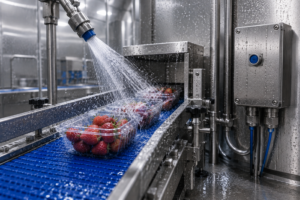
Washdown can place very different demands on equipment than an occasional wipe-down. Water may be sprayed from multiple directions and can reach seams, connectors, control panels, access doors, vents, and other enclosure interfaces. Higher-pressure cleaning can make these areas even more important.
For this reason, washdown needs to be considered across the complete equipment design. The enclosure may have an appropriate level of protection, but individual interfaces can still become potential entry points. Sealing, electrical connections, drainage, and component placement should therefore be considered together.
Seals and gaskets
Gaskets help prevent water and contaminants from entering enclosure interfaces, doors, covers, and other openings. Their material, compression, placement, and long-term durability should be considered during development. The surrounding geometry also needs to allow the seal to function consistently.
A seal needs to remain effective after repeated opening, closing, cleaning, and temperature changes. Engineers should therefore consider how the interface will perform over time rather than only during initial assembly.
Electrical connections
Connectors, cable entries, switches, displays, and other electrical interfaces can create potential ingress points. Their location and protection should be considered as part of the enclosure rather than after the internal electronics have already been packaged. This allows potentially vulnerable interfaces to be addressed while the overall architecture is still being developed.
Their position relative to the cleaning process also matters. Components exposed directly to water spray may require different protection than connections positioned away from the primary washdown area.
Drainage
Keeping water out is only part of washdown design. Equipment should also avoid creating areas where water becomes trapped. Standing moisture can make cleaning more difficult and may contribute to sanitation, corrosion, or reliability concerns over time.
Sloped surfaces, drainage paths, enclosure geometry, and component placement can help water move away from areas where it would otherwise remain. Drainage should therefore be considered as part of the mechanical design rather than as a separate feature added later.
Washdown requirements influence the entire product
Washdown requirements can influence more than the enclosure surrounding the equipment. Cleaning frequency, water pressure, temperature, chemicals, and drainage can affect materials, seals, joints, removable components, electrical interfaces, and long-term durability. These conditions need to be understood before individual components are selected.
The cleaning procedure should therefore become part of the equipment requirements. Understanding how the equipment will actually be cleaned gives the development team a better basis for making decisions about materials, protection, accessibility, and testing.
| Cleaning Condition | Design Consideration | Potential Impact |
|---|---|---|
| Frequent Cleaning | Surfaces, seals, hinges, latches, and removable components | Repeated cleaning can accelerate wear and expose sealing or durability issues over time. |
| Cleaning Chemicals | Metals, plastics, elastomers, coatings, and adhesives | Incompatible materials may corrode, crack, swell, soften, or otherwise degrade after repeated exposure. |
| Direct Water Spray | Enclosures, seams, cable entries, controls, and electrical connections | Water exposure may require greater ingress protection around sensitive electrical and mechanical components. |
| High-Pressure Washdown | Seals, enclosure joints, connectors, access panels, and exposed interfaces | Pressurized water can penetrate interfaces that may remain protected during splashing or lower-pressure cleaning. |
| Hot Water | Material temperature resistance, seals, and enclosure interfaces | Repeated temperature changes can affect material life, dimensional stability, and sealing performance. |
| Standing Water | Surface angles, drainage paths, joints, recesses, and equipment geometry | Poor drainage can leave water and residue in areas that are difficult to clean, dry, or inspect. |
These conditions show why washdown protection is a system-level consideration. Increasing enclosure protection alone does not address poor drainage, incompatible materials, inaccessible components, or interfaces that are repeatedly exposed during cleaning.
Designing removable components for cleaning
Some food-contact components may need to be removed regularly for cleaning or inspection. The way these components attach to the machine can have a significant effect on everyday usability. Parts that require tools, contain difficult-to-reach fasteners, or can be installed incorrectly may make routine cleaning more difficult.
Repeated removal also means that attachment features need to remain practical after continued use. Latches, locating features, threads, and other interfaces may be operated hundreds of times throughout the equipment’s service life.
Design considerations can include:
- Tool-less removal where appropriate for components that require frequent cleaning.
- Simple attachment and release mechanisms that reduce unnecessary steps during removal.
- Clear component orientation so parts can be returned to their proper position.
- Limited opportunities for incorrect assembly after cleaning or inspection.
- Accessible food-contact surfaces that can be reached without unnecessary disassembly.
- Durable latches and attachment features capable of supporting repeated use.
- Minimal loose hardware that must be handled separately during cleaning.
Balancing protection with accessibility
Sealing an enclosure can help protect internal components, but equipment still needs to be assembled, serviced, inspected, and repaired. This creates a practical engineering tradeoff. Increasing enclosure protection can introduce additional gaskets, covers, fasteners, and sealed interfaces, while service requirements may call for quick access to the same areas.
Neither requirement should be addressed independently. An enclosure that is extremely difficult to access can complicate maintenance, while excessive access points may create additional locations for water or contaminants to enter. The design needs to balance both requirements according to how the equipment will actually be used.
Considering protection and accessibility together can help engineers determine which components require frequent access and which can remain more permanently enclosed. This can provide appropriate environmental protection without creating unnecessary difficulty during maintenance.
Testing food equipment around the cleaning process
Testing should reflect the cleaning conditions the equipment is expected to experience during normal use. A design may perform correctly under normal operating conditions but respond differently after repeated exposure to water, chemicals, temperature changes, and disassembly. Testing should therefore consider both immediate performance and the effects of repeated cleaning.
Depending on the application, testing may evaluate:
- Water exposure and repeated washdown cycles to determine whether protected areas remain sealed.
- Seal performance around enclosure interfaces, doors, covers, and access points.
- Chemical compatibility and material degradation after exposure to expected cleaning agents.
- Corrosion and drainage in areas that regularly experience moisture.
- Repeated disassembly and reassembly of components intended to be removed for cleaning.
- Food or residue accumulation around surfaces, joints, and difficult-to-access locations.
- Performance after cleaning to confirm that the equipment continues operating as intended.
Food safety considerations throughout product development
Food safety requirements can influence mechanical design, electrical packaging, materials, manufacturing, and maintenance. Addressing them early gives engineering teams more flexibility to make changes before the overall architecture becomes difficult to modify. These requirements should continue to be considered as the product moves from initial requirements through prototyping, testing, and production.
A typical development process may include:
- Requirements Definition – Establish food-contact areas, cleaning procedures, environmental exposure, and expected operating conditions.
- Material Selection – Evaluate materials based on food contact, corrosion resistance, chemical compatibility, and durability.
- Mechanical Design – Develop surfaces, joints, enclosures, and removable components around cleanability.
- Prototype Development – Build representative systems for functional and cleaning evaluation.
- Testing – Evaluate ingress protection, washdown performance, material durability, and repeated cleaning.
- Design Refinement – Correct areas where water, residue, or contaminants can collect.
- Design for Manufacturing – Prepare the equipment for repeatable fabrication and assembly.
- Production Support – Maintain material, sealing, and assembly requirements as the design enters manufacturing.
Designing food equipment for repeated cleaning
A food-safe design needs to remain cleanable throughout the life of the equipment. Materials can degrade, seals can wear, surfaces can become damaged, and components may be removed and reinstalled hundreds of times. These conditions make long-term cleanability just as important as how the equipment performs when it is first placed into service.
Considering repeated cleaning during development helps create equipment that is easier to clean, inspect, maintain, and operate over repeated use. Material selection, IP protection, washdown requirements, enclosure design, drainage, and component accessibility all contribute to that goal. Each requirement should support the overall equipment design rather than being addressed independently.
Treating these factors as part of the product architecture from the beginning can reduce redesign and provide a stronger path from prototype to production. It also helps ensure that cleaning and maintenance requirements remain part of the design as the equipment progresses toward manufacturing.
Developing food and beverage equipment with Synectic
Synectic Product Development supports food and beverage equipment development through mechanical engineering, electrical engineering, embedded systems, prototype development, testing, and Design for Manufacturing. Food and beverage equipment can require several of these disciplines to work together because cleaning, environmental protection, mechanical operation, and electrical packaging frequently affect one another.
By defining food-contact, cleaning, environmental, and equipment requirements early, development teams can make more informed decisions about materials, enclosures, seals, components, and overall system architecture before moving toward production. Prototype development and testing can then provide opportunities to evaluate these decisions under conditions representative of actual use.
Considering cleanability throughout development provides a stronger foundation for equipment intended to withstand repeated operation and cleaning. The result is a development process that considers not only how the equipment needs to function, but also how it will be cleaned, serviced, maintained, and prepared for repeatable production.
Generate Better Concepts!
We’ve created a free workbook teaching you how to generate concepts that fit your product development needs.
Download your free workbook now!
About Synectic Product Development: Synectic Product Development is an ISO 13485-certified, full-scale product development company. Vertically integrated within the Mack Group, our capabilities allow us to take your design from concept to production. With over 40 years of experience in design, development, and manufacturing, we strive for ingenuity, cost-effectiveness, and aesthetics in our designs. Learn more about our product design services and see how we can help with your next project.