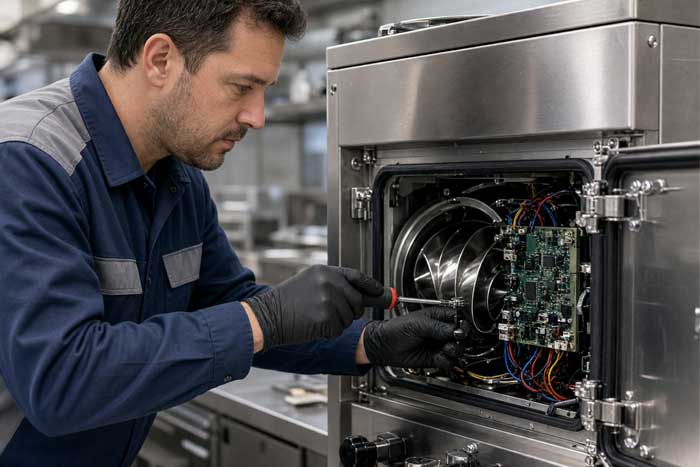
Downtime on a commercial food or beverage machine does not just stop a piece of equipment, it stops sales. A soft serve ice cream machine, blender, or self-serve kiosk that goes down during business hours means lost transactions until it is repaired, and that repair typically happens on-site, one unit at a time, often by a technician visiting several locations in a single day. Serviceability therefore becomes an important consideration alongside performance, portioning accuracy, and food safety compliance.
A machine that is difficult to open, troubleshoot, or repair can turn a relatively simple component replacement into a lengthy service event, and every extra minute on-site adds to the cost of the visit and the time a location goes without a working machine. Technicians may spend more time reaching and identifying the problem than actually replacing the failed component, which matters most when a technician has one opportunity to diagnose the issue and bring the correct part. Designing for serviceability can reduce these delays by considering maintenance access, component replacement, diagnostics, electrical architecture, and repair procedures before the equipment reaches production.
Serviceability does not mean making every component immediately accessible. The objective is to understand which components are most likely to require attention and design the equipment around realistic maintenance and repair needs. This allows engineering teams to prioritize access where it can have the greatest effect on equipment uptime and revenue at the point of service.
Where downtime actually comes from
Downtime does not always begin with a major system failure. Wear components, sensors, motors, belts, bearings, power supplies, connectors, and other relatively small parts can stop an otherwise functional machine from operating. The failed component itself may be inexpensive or straightforward to replace, but the service process surrounding that component can determine how long the equipment remains unavailable.
A technician first has to determine what failed. Surrounding panels or assemblies may then need to be removed, replacement parts located, connectors disconnected, and the repair completed before the machine can be reassembled and tested. If calibration or additional troubleshooting is required afterward, a relatively small failure can result in a much longer interruption.
Common contributors to extended downtime include:
- Difficult component access – Serviceable parts may be positioned behind unrelated assemblies, panels, wiring, or other equipment.
- Long troubleshooting procedures – Limited diagnostic information can require technicians to investigate several possible causes before identifying the fault.
- Excessive disassembly – Reaching one component may require removing several other parts that are functioning correctly.
- Specialized tools or difficult fasteners – Tool requirements, limited clearance, hidden attachment points, or inconsistent hardware can slow otherwise routine repairs.
- Poor fault identification – Technicians may have limited information about which subsystem or component is responsible for the problem.
- Complicated replacement and reassembly – Components that cannot be replaced independently may increase both repair time and the possibility of errors during reassembly.
Looking at downtime this way changes the engineering problem. Preventing failures remains important, but equipment can also be designed so that failures and maintenance events are easier to identify and address when they do occur.
Designing for serviceability
Serviceability considers how equipment will be maintained after it leaves development and begins regular operation. Components that are expected to wear, require inspection, need calibration, or occasionally fail should be positioned with maintenance in mind. Access panels, connectors, fasteners, wiring, and surrounding assemblies can all influence how quickly those components can be reached and replaced.
This does not mean every internal component needs the same level of accessibility. A filter replaced every month has a different service requirement than a component expected to last for the entire operating life of the machine. Maintenance frequency, failure consequence, replacement time, and component location can help determine how much design priority should be given to service access.
Considering these requirements while the equipment architecture is still developing provides more flexibility. Access and replacement paths can be incorporated into the mechanical and electrical design instead of being added after the enclosure, component placement, and internal packaging have already been established.
Access to high-service components
Frequently serviced parts should not require unnecessary removal of unrelated components. Filters, batteries, belts, sensors, valves, motors, and other maintenance items may benefit from dedicated access points or removable panels. The goal is to reduce the number of steps between identifying a service need and completing the work.
Access should also consider the technician performing the service. A component may appear accessible in CAD while still providing insufficient room for a hand, wrench, connector removal, or replacement part. Evaluating the complete service procedure can identify these problems before the design becomes fixed.
Modular assemblies
Breaking equipment into replaceable modules can make repairs easier when individual subsystems fail. Instead of disassembling a large mechanical or electrical system in the field, a technician may be able to remove and replace a complete module. The failed assembly can then be repaired separately without keeping the entire machine out of operation.
Modularity may be particularly useful for:
- Motor and drive assemblies that can be disconnected and replaced as a complete unit.
- Power supplies and control electronics that may be easier to troubleshoot or repair outside the machine.
- Dispensing and portioning mechanisms, such as augers, valves, or pumps, that experience wear from repeated dispensing cycles.
- Mixing and blending assemblies that require periodic inspection, cleaning, or replacement.
- Touchscreen and user-interface components that may need replacement without disturbing the rest of the system.
- Frequently serviced mechanical systems where repeated disassembly would otherwise increase service time.
Modularity introduces its own design requirements, including additional interfaces, connectors, mounting features, and packaging considerations. The benefit should therefore be evaluated according to how frequently the assembly is expected to require service and how much downtime its replacement could create.
Serviceability in compact, high-traffic equipment
Countertop and kiosk-format equipment presents a different serviceability challenge than large industrial machines. A soft serve ice cream machine, blender, or multi-ingredient dispenser has to fit within a limited footprint while still providing enough internal clearance for a technician to reach fasteners, connectors, and wear components. The same access requirements apply, but there is less room to satisfy them.
These machines are also typically deployed across many individual locations rather than concentrated on a single production floor, and a technician may service several units in different locations in a single day. Design decisions that support a first-visit fix, such as diagnostics that identify the specific failed component before a technician arrives or fault indicators that point to a likely cause rather than a general malfunction, can reduce both the cost of the service call and the time the unit spends out of service.
Automated cleaning and sanitization cycles add another consideration. Components that support an automated wash cycle need to remain sealed and food-safe during normal operation, while some of those same components may need to be reachable during a service event. Coordinating these requirements early can prevent a design that satisfies sanitation requirements from becoming unnecessarily difficult to service.
Considerations specific to this equipment category include:
- Limited internal clearance – Compact enclosures leave less room for hands, tools, and connector access than larger equipment.
- Field-service logistics – Technicians often service multiple locations in a single day, making first-visit diagnosis and repair particularly valuable.
- Coexistence with automated cleaning cycles – Components that support washdown or sanitization cycles need to remain sealed during normal operation while still being reachable during service.
- Operator-level troubleshooting – Basic fault indication accessible to on-site staff can resolve some issues without requiring a technician visit at all.
These constraints do not replace the design principles already discussed, they make the tradeoffs between access, protection, and footprint more pronounced.
Reducing time spent diagnosing failures
Repair time starts before a technician removes the first fastener because the problem first has to be identified. Equipment with limited diagnostic information may require technicians to inspect several possible causes before locating the actual fault. In complex systems, that troubleshooting process can account for a significant portion of the total service event.
Appropriate system diagnostics can narrow the search by providing information about the condition of the equipment and its subsystems. Diagnostics do not need to identify every possible failure automatically, but they should give technicians a useful place to begin. The information provided should support troubleshooting without introducing unnecessary system complexity.
Depending on the equipment, diagnostics may include:
- Error codes and status indicators – Providing immediate information about system state or detected faults.
- Sensor feedback – Allowing technicians to determine whether expected inputs and outputs are being detected.
- Current and voltage monitoring – Helping identify abnormal electrical behavior or power-related issues.
- Temperature monitoring – Identifying overheating or unexpected thermal conditions.
- Cycle counts – Providing information that can be compared with expected component life or maintenance intervals.
- Maintenance alerts – Identifying scheduled inspection or replacement needs before they become unexpected failures.
- Software logs – Preserving information about system behavior leading up to a fault.
Diagnostics should ultimately help technicians determine which subsystem is likely responsible and what should be investigated next. Useful fault information can reduce unnecessary disassembly and shorten the time between the initial failure and the actual repair.
Designing around common service events
Not every component deserves the same serviceability strategy. A useful approach is to consider how frequently a component is expected to require attention, how difficult it is to replace, and what happens to the equipment when it fails. These factors can help engineering teams determine where direct access, modular replacement, diagnostics, or other service features provide the greatest value.
A frequently replaced filter, for example, benefits from simple access because the service event will occur repeatedly throughout the equipment’s life. A critical component may require a different approach because the priority is restoring operation quickly after an unexpected failure. A component that rarely requires service may justify less direct access if additional openings would compromise sealing, structural integrity, or packaging.
| Service Situation | Design Priority | Serviceability Approach |
|---|---|---|
| Frequent Maintenance | Minimize routine service time | Provide direct access, simple fasteners, and clear maintenance points. |
| Wear Components | Make replacement predictable | Design components so they can be removed without disturbing surrounding assemblies. |
| Critical Components | Minimize time to restore operation | Consider modular replacement and accessible electrical or mechanical connections. |
| Hard-to-Diagnose Systems | Reduce troubleshooting time | Incorporate useful diagnostics, status information, and test points. |
| Calibration-Dependent Components | Reduce post-repair setup | Design interfaces and mounting features that maintain alignment where possible. |
| Low-Frequency Service Items | Balance access with packaging | Provide reasonable access without compromising the overall equipment architecture. |
This approach helps prevent serviceability from becoming an all-or-nothing requirement. Engineering effort can instead be concentrated on the service events most likely to affect uptime while lower-priority components remain appropriately integrated into the equipment.
Fasteners and access can make a major difference
Small mechanical decisions can have a significant effect on service time. A technician working inside a machine may need to remove several panels or assemblies before reaching a failed component. Different fastener types, hidden screws, limited tool clearance, or loose hardware can make the process unnecessarily difficult even when the component itself is simple to replace.
These details are easy to overlook because they may have little effect on how the equipment performs during normal operation. Their importance becomes more apparent during maintenance, when each additional panel, fastener, or difficult connection adds another step to the service procedure. Repeated across several service events, relatively small design decisions can have a meaningful effect on equipment availability.
Design choices that can simplify service include:
- Consistent fastener types – Reducing the number of different tools required during routine maintenance.
- Adequate tool clearance – Providing enough space to reach fasteners and connectors without removing unrelated components.
- Reduced unnecessary fastener counts – Using enough hardware to satisfy the design requirements without adding unnecessary service steps.
- Captive hardware where appropriate – Preventing loose screws or other hardware from being misplaced during service.
- Visible attachment points – Avoiding hidden fasteners that make disassembly less intuitive.
- Removable access panels – Providing direct routes to components expected to require inspection or replacement.
- Reachable connectors – Positioning electrical and mechanical connections where they can be disconnected during service.
The best solution depends on the enclosure, environment, structural requirements, and expected maintenance procedure. The important consideration is whether routine service tasks can be completed without unnecessary obstacles created by the equipment itself.
Electrical design for easier service
Electrical architecture can influence downtime in many of the same ways as mechanical packaging. A replaceable electrical assembly may still be difficult to service if its connectors are inaccessible, wiring has to be removed from unrelated systems, or the technician cannot isolate the source of the fault. Serviceability should therefore be considered when electrical systems and harness routing are being developed. Connectors should be positioned so that serviceable assemblies can be disconnected without unnecessarily disturbing surrounding wiring. Harness routing should provide enough access for inspection and replacement while still protecting wiring during normal equipment operation. Clearly separated electrical assemblies can also make troubleshooting easier by helping technicians isolate faults to a specific subsystem.
Where appropriate, design teams may consider:
- Accessible connectors that can be reached without excessive disassembly.
- Modular wiring harnesses that allow sections of the electrical system to be serviced independently.
- Clearly separated electrical subsystems that make fault isolation more straightforward.
- Test points that provide useful measurements during troubleshooting.
- Protection against incorrect connections during reassembly or module replacement.
- Replaceable control or power modules where field replacement is more practical than component-level repair.
- Logical cable routing that supports inspection while maintaining appropriate protection.
Electrical serviceability should be coordinated with mechanical access. A removable module provides limited benefit if the connector cannot be reached, just as an accessible connector provides limited benefit if the assembly cannot physically be removed from the enclosure.
Designing for maintenance without compromising the machine
Serviceability has to be balanced with other product requirements. Adding access panels can affect enclosure strength, sealing, appearance, cost, and manufacturing complexity. Modular assemblies may require additional connectors or mounting hardware, while increasing internal access can require more packaging space or a larger enclosure.
These tradeoffs mean that maximum accessibility is not always the best design. The appropriate level of service access depends on the equipment, expected operating environment, maintenance frequency, component reliability, and consequences of downtime. A component expected to last the life of the product may reasonably be more difficult to reach than a filter or belt replaced during routine maintenance.
The objective is to prioritize serviceability where it provides meaningful value without unnecessarily compromising the rest of the product. Understanding expected service events early gives engineering teams a basis for making those decisions while the overall architecture can still be adjusted.
Preventive maintenance and equipment uptime
Serviceability can also support preventive maintenance. Equipment does not have to experience a complete failure for downtime to occur, and routine inspection can identify worn or deteriorating components before they stop the machine unexpectedly. Access therefore matters during scheduled maintenance as well as emergency repair. If inspection points and wear components are difficult to reach, routine maintenance may take longer or be postponed. Making these areas easier to inspect can help technicians identify wear while there is still an opportunity to schedule replacement. This can shift some service activity from unexpected downtime toward planned maintenance.
Areas that may benefit from routine access include:
- Bearings and lubrication points that require inspection or periodic lubrication.
- Filters that need cleaning or replacement at established intervals.
- Belts and drive components that can wear, stretch, or require adjustment.
- Seals that may deteriorate and create leaks or contamination concerns.
- Cooling systems that require inspection or cleaning to maintain performance.
- Sensors and electrical connections that may require inspection, adjustment, or replacement.
- Other known wear items identified through component specifications or field experience.
Maintenance access should therefore be considered during the same development stages as component placement and mechanical packaging. The easier it is to complete necessary preventive maintenance, the more practical it becomes to keep the equipment operating as intended.
Testing the service process
Equipment testing commonly focuses on whether the machine performs its intended function. Service procedures should also be evaluated before the design is finalized because some access and maintenance problems are difficult to recognize from CAD alone. Physically performing representative repairs can reveal issues involving tool clearance, component removal, connector access, and reassembly. A service exercise should represent the work a technician would actually perform rather than simply confirming that a component can theoretically be removed. Engineers can observe the sequence of steps, determine which surrounding parts have to be disturbed, and identify areas where the service procedure creates unnecessary difficulty. Engineering teams can evaluate:
- Repair time and procedure – How long representative maintenance or replacement tasks take and how many steps are required.
- Component removal – How many unrelated components have to be removed before reaching the service item.
- Tool and connector access – Whether technicians can physically reach the necessary fasteners, connectors, and test points.
- Replacement paths – Whether components can actually pass through the available enclosure openings after being disconnected.
- Reassembly – Whether components, connectors, and hardware can be returned to their correct positions without unnecessary ambiguity.
- Post-repair requirements – Whether replacement requires calibration, alignment, configuration, or other additional work.
- Diagnostic accuracy – Whether system diagnostics correctly identify representative or simulated faults.
Finding these problems during prototype development is generally much easier than discovering them after equipment has entered the field. Service testing can therefore become another source of design feedback alongside functional, performance, and reliability testing.
Serviceability during product development
Service requirements should be considered before the equipment architecture becomes fixed. Once enclosure dimensions, component locations, electrical routing, and major assemblies have been established, improving service access can require substantial redesign. Introducing serviceability requirements earlier gives the engineering team more opportunities to incorporate them naturally into the product. Serviceability should also continue to be evaluated as the design progresses. Prototype testing may reveal that a component expected to be accessible still requires excessive disassembly or that a diagnostic feature does not provide enough information to identify the actual fault. These findings can then be incorporated into later design revisions.
A typical development process may include:
- Requirements Definition – Identify maintenance intervals, expected service life, critical components, and uptime requirements.
- System Architecture – Organize mechanical and electrical systems with access and replacement in mind.
- Component Selection – Consider reliability, expected lifespan, availability, and replacement requirements.
- Prototype Development – Build representative systems that allow both functional and service evaluation.
- Service Testing – Perform common maintenance and repair procedures on prototypes.
- Design Refinement – Improve access, diagnostics, modularity, and component replacement based on testing.
- Design for Manufacturing – Balance serviceability with efficient assembly and production requirements.
- Production and Lifecycle Support – Use field experience to identify recurring failures and opportunities for future design improvements.
This allows serviceability to develop alongside the equipment instead of becoming a requirement addressed at the end. Decisions about access, diagnostics, modularity, and maintenance can then be evaluated while changes are still more practical to make.
Designing for the full equipment lifecycle
Serviceability becomes increasingly important as equipment accumulates operating hours. Components wear, maintenance intervals become clearer, replacement parts may change, and field experience can reveal issues that were difficult to predict during initial development. Equipment designed with accessible and replaceable systems is generally easier to support as these needs develop.
The service strategy also extends beyond the physical design. Replacement parts, assembly information, maintenance procedures, software or firmware information where applicable, and revision control can all influence whether a machine remains practical to repair throughout its operating life. A serviceable design is more useful when technicians also have the information and parts required to perform the work.
Field experience can then provide information for future improvements. Recurring failures, difficult repairs, and frequently replaced components can identify opportunities to refine later revisions or future equipment. Serviceability therefore continues beyond the initial product development process.
Designing serviceable equipment with Synectic
Synectic Product Development supports food and beverage equipment development through mechanical engineering, electrical engineering, embedded systems, prototype development, testing, and Design for Manufacturing.
Serviceability can be evaluated alongside performance, portioning accuracy, food safety compliance, and other system requirements throughout development. By considering how dispensing, mixing, and preparation equipment will be diagnosed, maintained, and repaired before production, engineering teams can develop systems that stay in service and keep generating revenue at the point of sale.
Generate Better Concepts!
We’ve created a free workbook teaching you how to generate concepts that fit your product development needs.
Download your free workbook now!
About Synectic Product Development: Synectic Product Development is an ISO 13485-certified, full-scale product development company. Vertically integrated within the Mack Group, our capabilities allow us to take your design from concept to production. With over 40 years of experience in design, development, and manufacturing, we strive for ingenuity, cost-effectiveness, and aesthetics in our designs. Learn more about our product design services and see how we can help with your next project.