
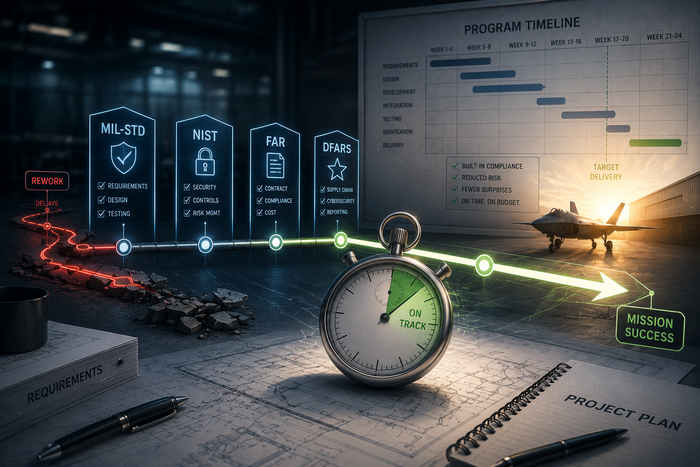
Military standards are designed to verify that products can perform reliably in demanding operational environments, but successful qualification rarely begins in the test lab. It begins during product development. Engineering decisions surrounding materials, structural design, electronics, thermal management, and environmental protection all influence whether a product can successfully meet military performance requirements. By designing with MIL-STD compliance in mind from the outset, organizations can reduce costly redesigns, improve testing readiness, and keep development programs moving toward production.
Where MIL-STD programs lose time
Successfully meeting MIL-STD requirements isn’t simply a matter of passing qualification testing. More often than not, development timelines are impacted by engineering challenges that surface throughout the design process. When critical requirements aren’t addressed early, teams may find themselves redesigning components, rebuilding prototypes, updating documentation, or repeating qualification testing, all of which can significantly extend development schedules.
Many of these delays are preventable. By integrating qualification requirements into product development from the outset, engineering teams can identify technical risks while designs are still flexible, reducing the likelihood of costly changes later in the program. The goal isn’t to eliminate qualification testing, it’s to minimize the engineering issues that commonly slow progress toward production.
Some common causes of schedule delays:
- Requirements Identified Too Late: Environmental, electrical, or customer-specific requirements discovered after major design decisions often require significant engineering changes and additional prototype iterations.
- Qualification Test Failures: Products that haven’t been engineered with shock, vibration, thermal, EMC, or environmental conditions in mind may require redesigns before testing can be successfully completed.
- Prototype Revisions: Multiple prototype builds are sometimes necessary when performance issues aren’t identified until late in development, increasing both cost and schedule.
- Documentation & Configuration Changes: Updating drawings, bills of materials (BOMs), specifications, and revision-controlled documentation following design changes can delay qualification and manufacturing activities.
- Supplier & Component Changes: Material substitutions, obsolete components, or manufacturing constraints may require additional engineering validation and qualification efforts before production can continue.
- Disconnected Development Processes: When engineering, prototyping, testing, and manufacturing are managed separately, communication gaps and repeated handoffs can slow decision-making and extend development timelines.
Every delay has a ripple effect. A failed environmental test may require mechanical redesigns, updated documentation, new prototype builds, additional verification, and rescheduled laboratory testing before qualification can resume. Addressing these risks earlier through an integrated engineering approach helps reduce avoidable iterations, improve schedule predictability, and keep defense programs moving toward production.
Designing for qualification instead of designing for failure
Qualification testing should validate a product’s performance, not reveal engineering issues for the first time. Yet many development programs rely on formal testing to identify weaknesses in structural design, thermal performance, electromagnetic compatibility, or environmental protection. While testing is intended to confirm that a product meets military requirements, discovering fundamental design issues during qualification often leads to redesigns, additional prototype iterations, and extended development timelines.
Designing for qualification means incorporating applicable military standards, mission requirements, and expected operating conditions into the engineering process from the beginning. Rather than reacting to failures after testing, engineering teams can evaluate material selection, structural integrity, thermal management, electromagnetic compatibility, environmental sealing, and manufacturing considerations throughout development. This proactive approach helps identify potential issues while designs are still flexible, making improvements faster and more cost-effective.
At Synectic, qualification is treated as an engineering objective rather than a final project milestone. By integrating mechanical, electrical, software, manufacturing, and systems engineering throughout product development, our team helps clients reduce technical risk, streamline design iterations, and prepare products for qualification testing with greater confidence. The result is a more predictable development process that supports testing readiness while helping keep defense programs on schedule.
Engineering decisions that reduce qualification risk
Successful qualification testing is built on engineering decisions made throughout product development. Every choice, from material selection to PCB layout, can influence how a product performs during environmental, electrical, and mechanical testing. Addressing these considerations early helps reduce technical risk, minimize redesigns, and improve confidence before formal MIL-STD qualification begins.
- Material Selection: Selecting materials based on the intended operating environment helps improve durability while reducing the risk of failures caused by temperature extremes, corrosion, vibration, or mechanical stress.
- Structural Design: Designing enclosures, mounting features, and internal supports to withstand operational loads helps minimize structural failures that could require redesigns following shock or vibration testing.
- Thermal Management: Evaluating heat generation and cooling strategies early helps maintain reliable system performance and reduces the likelihood of temperature-related issues during qualification.
- Electromagnetic Compatibility (EMC): Considering grounding, shielding, PCB layout, filtering, and cable routing throughout development helps reduce electromagnetic interference and supports a smoother path through MIL-STD-461 testing.
- Environmental Protection: Designing appropriate sealing methods, enclosure interfaces, and protective features helps prepare products for moisture, dust, contaminants, and other environmental challenges encountered during qualification.
- Electrical & Mechanical Integration: Coordinating connectors, cable management, mounting interfaces, and system integration early in development helps improve reliability while reducing integration issues that can delay testing and production.
By integrating these engineering considerations throughout the design process, organizations can identify potential qualification challenges before they become costly engineering changes. Rather than relying on formal testing to uncover fundamental design issues, teams can enter qualification with greater confidence, improving schedule predictability and creating a more efficient path toward production.
In practice, these decisions play out differently by platform. Unmanned aerial system (UAS) programs tend to see the most schedule risk in thermal and vibration qualification under flight conditions. Unmanned ground vehicle (UGV) programs more often stall on shock and structural durability testing tied to field operation. Unmanned surface vessel (USV) programs typically run into environmental sealing and corrosion qualification failures tied to sustained marine exposure. Knowing where your platform is most likely to fail early lets you weight your pre-compliance testing accordingly.
The cost of a failed qualification test
A failed qualification test rarely affects only the testing phase. Once a weakness is discovered, the program may need to pause while engineers investigate the cause, modify the design, update documentation, rebuild test articles, repeat internal verification, and secure another laboratory testing window. The resulting delay can also affect supplier commitments, manufacturing schedules, customer milestones, and overall program cost.
The most damaging part is often the chain reaction. A vibration failure may require changes to the enclosure, mounting system, internal supports, components, or assembly methods. Those changes can then affect thermal performance, electromagnetic compatibility, manufacturing processes, and the approved product configuration. Synectic helps reduce this risk by addressing qualification requirements throughout development and coordinating the engineering, prototyping, verification, documentation, and manufacturing activities needed to respond efficiently when issues are identified.
When should MIL-STD requirements enter the design process?
MIL-STD requirements should be considered as early as possible, ideally during requirements definition and system architecture, before major decisions about materials, enclosure design, electronics, components, interfaces, and manufacturing methods have been finalized. At this stage, engineering teams still have the flexibility to shape the product around its intended operating environment rather than redesigning it later to meet requirements that were identified too late.
Early integration does not mean performing full qualification testing at the beginning of development. It means translating the applicable standards, mission conditions, and customer requirements into practical engineering inputs. Shock and vibration expectations may influence mounting strategies and structural support. Thermal requirements can affect component placement, airflow, and enclosure geometry. EMC requirements may shape PCB layout, grounding, shielding, filtering, and cable routing. Environmental exposure can determine sealing methods, materials, coatings, and connector selection.
As the design progresses, these requirements should remain part of each engineering review, prototype build, and verification activity. Analysis, simulation, bench testing, and pre-compliance evaluations can then be used to identify weaknesses before formal qualification begins. This creates a staged approach in which qualification readiness is developed throughout the program instead of treated as a final checkpoint.
Bringing MIL-STD requirements into the process early helps reduce late-stage design changes, repeated prototype builds, documentation revisions, and avoidable retesting. The earlier the requirements are understood, the more efficiently they can be incorporated into the product, and the less likely they are to disrupt the development timeline.
How Synectic helps protect the development timeline
Keeping a defense program on schedule requires more than designing a product that can pass qualification testing. It requires an engineering process that identifies risks early, responds quickly to design challenges, and maintains configuration control throughout verification. By addressing qualification requirements from the beginning of development, Synectic helps reduce unnecessary retesting and keeps programs moving toward production with greater confidence.
- Early Requirements Integration: Applicable MIL-STDs, customer specifications, and mission requirements are translated into engineering inputs at the beginning of development, helping reduce late-stage design changes that can delay qualification.
- Prototype Development & Design Verification: Representative prototypes, engineering analysis, simulation, and verification activities help identify potential issues before formal qualification testing begins, reducing the likelihood of costly test failures.
- Rapid Design Iteration: When testing identifies a problem, engineering, prototyping, and verification activities are coordinated to shorten the time between identifying an issue and implementing an effective, test-ready solution.
- Configuration & Documentation Management: Engineering revisions are tracked specifically to prevent an approved, qualified configuration from drifting after testing, one of the most common causes of avoidable requalification and retesting.
- Qualification-Aware Production Planning: Manufacturing process and material changes are evaluated for their potential to trigger re-verification, helping ensure production decisions do not unintentionally invalidate a qualified design.
By integrating engineering, verification planning, configuration control, and qualification-focused decision making throughout development, Synectic helps reduce qualification risk, improve schedule predictability, and keep defense programs moving efficiently from testing toward production.
Ready to reduce qualification risk?
Successfully navigating MIL-STD qualification starts long before testing begins. By integrating qualification requirements into the engineering process from day one, organizations can reduce technical risk, minimize costly redesigns, and improve schedule predictability throughout product development.
Whether you’re developing a new defense system, adapting an existing product for military applications, or preparing for formal qualification testing, Synectic provides the multidisciplinary engineering expertise to help move your program from concept to manufacturing with confidence.
Generate Better Concepts!
We’ve created a free workbook teaching you how to generate concepts that fit your product development needs.
Download your free workbook now!
About Synectic Product Development: Synectic Product Development is an ISO 13485-certified, full-scale product development company. Vertically integrated within the Mack Group, our capabilities allow us to take your design from concept to production. With over 40 years of experience in design, development, and manufacturing, we strive for ingenuity, cost-effectiveness, and aesthetics in our designs. Learn more about our product design services and see how we can help with your next project.