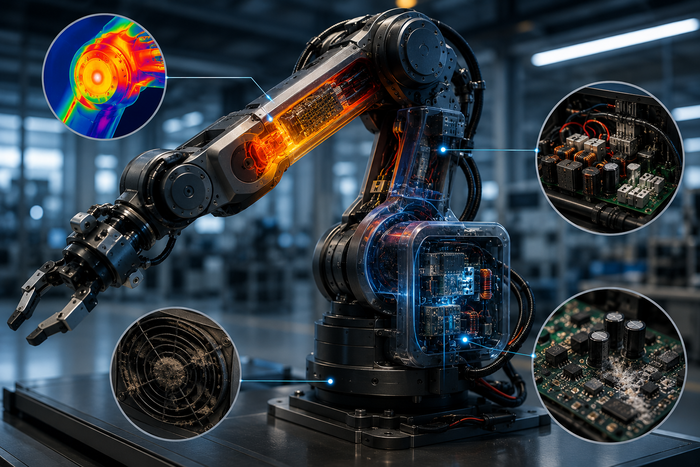
A robotic system can perform its intended movements and still have engineering problems developing beneath the surface. Motors may be operating near their thermal limits, batteries may experience higher peak loads than expected, or mechanical and electrical components may be accumulating wear that does not appear during short prototype tests. These conditions can exist even while the robot appears to be functioning correctly.
The risks become more important as operating time and system demand increase. A robot that performs correctly for ten minutes may behave differently after several hours of continuous operation, under maximum payload, in a warmer environment, or after thousands of repeated cycles. Changes in one part of the system can also create additional demands elsewhere, making the source of a problem less obvious.
Thermal performance, power demand, and long-term reliability should therefore be evaluated alongside basic functionality throughout robotic product development. Understanding how these areas interact can help engineering teams identify problems before they become field failures or require larger design changes.
Why some robotics problems are difficult to identify early
Early prototypes are often used to answer fundamental questions about a robotic system. Engineers need to determine whether the mechanism can move correctly, whether sensors can detect the required information, and whether software can control the system as intended. Successfully answering those questions is an important part of development, but it does not necessarily show how the robot will perform over time.
Heat can gradually accumulate inside an enclosure. Motors may experience brief current spikes during acceleration, connectors can loosen under repeated movement, cables can fatigue, and bearings or gears can wear. Small mechanical changes can also increase friction and place additional load on motors and the electrical system.
Many of these conditions become visible only when the robot is tested under representative loads and operating cycles. Development testing therefore needs to move beyond proving that the system works and begin evaluating how consistently it works as operating conditions change.
Thermal risks in robotic systems
Robots can contain several significant heat sources within a relatively small package. Motors, motor controllers, batteries, processors, power supplies, and other electronics may all generate heat at the same time. When these components are packaged together, the temperature of one system can influence the operating environment of another.
The challenge is therefore not limited to the maximum temperature of each individual component. Engineers also need to consider where heat travels, where it becomes trapped, how quickly it can dissipate, and how the complete system behaves after reaching a steady operating temperature. These conditions can differ significantly from what is observed during short prototype tests.
Motors under sustained load
Motor temperature can change significantly depending on torque, speed, duty cycle, mechanical resistance, and the surrounding environment. A motor that remains cool during intermittent prototype testing may become much hotter when the robot performs the same movement continuously. Increased payload, friction, or frequent acceleration can raise the load further.
This makes the expected operating cycle an important part of motor selection. Producing the required peak torque does not necessarily mean that a motor can repeatedly produce that output while remaining within acceptable thermal limits. Sustained operation should therefore be evaluated along with peak mechanical capability.
Heat inside enclosed electronics
Thermal management can involve several parts of the design rather than one isolated cooling component. Depending on the application, engineering teams may consider:
- Heat sinks and conductive heat paths – Moving heat away from components and toward surfaces where it can dissipate more effectively.
- Ventilation or active cooling – Increasing airflow where the operating environment and enclosure requirements allow it.
- Component spacing and placement – Avoiding unnecessary concentration of multiple heat-producing components in the same area.
- Temperature monitoring – Providing information about component or enclosure temperatures during operation.
- Enclosure design – Considering how geometry, materials, sealing, and internal packaging influence heat transfer.
- Software-based thermal limits – Reducing system demand or changing operation when temperatures approach defined limits.
The appropriate approach depends on the operating environment and the amount of heat that needs to be managed. Thermal requirements should therefore be considered alongside enclosure protection, packaging, serviceability, and other system requirements rather than after those decisions have already been made.
Ambient temperature matters
The robot does not always begin operation at room temperature. Equipment used outdoors, near industrial processes, or in other uncontrolled environments may already be exposed to elevated or changing temperatures before motors and electronics begin generating additional heat. The surrounding environment consequently affects how much thermal margin remains available during operation.
Ambient temperature should be included when defining representative operating conditions. A system that remains within acceptable limits in a controlled laboratory may have considerably less thermal margin when operating in a warmer environment. Testing should account for those expected conditions rather than assuming room-temperature operation.
Where thermal problems can originate
Different heat sources create different risks, and the appropriate solution may involve mechanical, electrical, enclosure, or software changes. Looking at the complete system can help identify whether heat is being generated by normal electrical losses, increased mechanical loading, restricted cooling, or several conditions occurring together.
| Heat Source | What Can Increase Temperature | Potential System Effect |
|---|---|---|
| Motors & Actuators | High torque, frequent acceleration, increased friction, or long duty cycles | Reduced performance, thermal shutdown, or shortened component life |
| Motor Controllers | High current demand and repeated peak loads | Increased electronics temperature and potential current limiting |
| Batteries | High discharge rates, charging, and elevated ambient temperature | Reduced available performance, accelerated degradation, or protective shutdown |
| Processors | High computational load and limited airflow | Thermal throttling or inconsistent computing performance |
| Power Electronics | Conversion losses and sustained electrical demand | Localized heating inside electrical enclosures |
| Enclosed Assemblies | Limited airflow and closely packaged components | Heat accumulation across multiple components |
Thermal testing should evaluate these sources together because components do not operate in isolation. Heat generated by one subsystem can raise the surrounding temperature experienced by another, reducing its available thermal margin even if that second component is operating normally.
Power demand is rarely constant
A robot’s average power consumption does not tell the complete story. Motors can draw substantially more current while accelerating, lifting a load, overcoming resistance, or recovering from a stalled condition. Multiple actuators may also operate simultaneously, creating short periods when electrical demand is significantly higher than the typical operating load.
These short-duration conditions still have to be supported by the battery, wiring, connectors, motor controllers, protection devices, and power-distribution architecture. If the system is designed primarily around average demand, peak loads can create voltage drops, excessive heating, protective shutdowns, or unexpected resets.
Power requirements should therefore be evaluated across representative operating scenarios. Maximum payload, simultaneous actuator operation, changing battery state, and mechanical resistance can all influence the electrical demand seen by the system.
Peak current
Peak electrical demand can occur quickly. A robot may operate normally until several actuators accelerate simultaneously or a mechanism encounters additional resistance. The resulting current demand can be substantially different from what is observed during steady operation.
Battery capability, wiring, connectors, protection devices, motor controllers, and power distribution all need to support these expected peaks. Testing should therefore capture transient electrical behavior in addition to average power consumption.
Voltage stability
High current demand can cause system voltage to drop, and the effect may extend beyond the motors creating the load. Processors, sensors, communication hardware, and control electronics may share the same power architecture. A temporary voltage problem can consequently appear as a sensing, communication, or software problem elsewhere in the robot.
If voltage falls outside the acceptable range of those systems, the result can include sensor errors, communication interruptions, controller resets, or unexpected behavior. Understanding these relationships can prevent engineering teams from troubleshooting the visible symptom while overlooking the underlying electrical condition.
Available power margin
Designing a power system around the exact calculated requirement leaves little room for changing operating conditions. Payload variation, mechanical wear, additional sensors, software updates, component tolerances, or future system changes can all increase electrical demand after the initial design calculations are complete.
Providing appropriate margin gives the electrical architecture room to accommodate these variations. The amount of margin should reflect the application and expected operating conditions rather than simply adding capacity without considering the effect on weight, packaging, cost, and thermal performance.
How mechanical conditions affect electrical demand
Power problems can sometimes begin as mechanical problems. A bearing that develops additional resistance requires the motor to produce more torque, poor alignment can increase friction, and a heavier payload changes acceleration requirements. Contamination or wear within a drivetrain can similarly increase the force required to produce the same movement.
These mechanical changes can increase motor current and generate additional heat even when nothing in the electrical system has directly failed. A robot may therefore begin consuming more power because its mechanical condition has changed over time.
This relationship makes electrical measurements useful beyond battery and runtime calculations. A gradual change in current consumption under otherwise similar operating conditions can provide an indication that friction, loading, alignment, or another part of the system is changing. Mechanical and electrical performance should therefore be evaluated together when investigating unexpected power demand.
Reliability problems build over time
Reliability is difficult to judge from a prototype that has completed only a limited number of operating cycles. Robotic systems contain moving parts, flexible cables, connectors, bearings, gears, seals, sensors, and electronics that may experience thousands or millions of repeated cycles throughout the product’s operating life. Problems that are invisible during initial testing can gradually develop as those cycles accumulate.
Reliability testing should reflect how the robot actually moves and operates rather than considering component life only in isolation. Repeated motion, vibration, temperature changes, payload variation, and environmental exposure can all influence how components age. Several relatively small changes can also combine to affect overall system performance.
Cable and connector fatigue
Robotic motion can repeatedly bend, twist, or pull electrical cables. Routing that works during initial assembly may eventually create stress near connectors, sharp bends, or moving joints after enough operating cycles.
Cable selection, bend radius, strain relief, routing, and connector retention should reflect the actual movement of the robot. Endurance testing can help determine whether repeated motion is creating stress that was not apparent during initial assembly or short-duration testing.
Mechanical wear
Bearings, gears, belts, bushings, seals, and other mechanical components change as they accumulate operating cycles. Wear can increase backlash, friction, vibration, or positioning error even before a component experiences a complete failure.
Those mechanical changes can then influence other parts of the robot. Increased friction can raise motor current and temperature, while additional backlash can affect positioning accuracy and require greater control correction. Reliability therefore needs to be evaluated as a system-level issue rather than only as component failure.
Vibration and loosening
Repeated movement can introduce vibration into fasteners, connectors, sensors, circuit boards, and other assemblies. Components that remain secure during short testing may gradually loosen after extended operation.
Fastener strategy, connector retention, mounting methods, and vibration isolation may therefore need to be evaluated during endurance testing. The objective is to understand whether repeated operation changes the mechanical or electrical connections that the system depends on.
Sensor drift and calibration
Sensor performance can also change over time. Mechanical movement, temperature variation, vibration, or wear can alter alignment and calibration even when the sensor itself remains functional.
If the control software assumes that the original relationship remains unchanged, accuracy may gradually decrease without an obvious component failure. Calibration requirements should therefore account for the mechanical and environmental conditions that may influence sensing throughout the product’s operating life.
Hidden risks often affect more than one system
Thermal, power, mechanical, and reliability issues are closely connected. A change in one area can create secondary effects elsewhere in the robot, which can make the original source difficult to identify. A visible electrical problem, for example, may originate from increased mechanical friction rather than from the electrical architecture itself.
| Initial Condition | Immediate Effect | Possible Secondary Risk |
|---|---|---|
| Increased Mechanical Friction | Motor requires more torque | Higher current draw and increased motor temperature |
| Higher Payload | Greater actuator load | Reduced battery life, additional heat, and increased mechanical wear |
| Restricted Cooling | Internal temperature rises | Electronics throttling and reduced component life |
| Battery Degradation | Available capacity and performance decrease | Shorter operating time or reduced ability to support peak loads |
| Loose Connector | Intermittent electrical connection | Sensor faults, communication errors, or unexpected resets |
| Mechanical Backlash | Reduced positioning accuracy | Increased control corrections and inconsistent motion |
| Sensor Misalignment | Less accurate feedback | Incorrect control response or repeated calibration problems |
Looking at these relationships can help engineering teams trace a visible problem back to its actual source rather than treating each symptom independently. It also demonstrates why thermal, electrical, mechanical, and controls testing should not be performed as completely separate activities.
Duty cycle changes the engineering requirements
How frequently a robot performs a task can be just as important as what the task requires. A mechanism operating for several seconds followed by a long idle period may have enough time to dissipate heat between cycles. The same mechanism performing that movement continuously may reach a much higher steady-state temperature.
Duty cycle also affects the rate at which components accumulate wear and the amount of demand placed on batteries, electronics, and cooling systems. Requirements should therefore describe not only what the robot needs to do, but how often and for how long it is expected to do it.
Important duty-cycle considerations include:
- Motors – Continuous or frequently repeated operation changes thermal requirements and expected service life.
- Batteries – Repeated high-current operation can affect runtime, temperature, and available performance.
- Mechanical components – More cycles increase accumulated wear on bearings, gears, belts, bushings, and joints.
- Electronics – Sustained processing and control loads can increase enclosure temperature over longer operating periods.
- Cooling systems – Fans and other active cooling components accumulate operating hours and may introduce their own maintenance or reliability requirements.
Expected operating cycles should therefore be established during requirements development and recreated during testing where practical. Without representative duty cycles, a prototype may successfully demonstrate the intended function without reproducing the conditions that will eventually determine thermal and reliability performance.
Prototype testing should go beyond basic functionality
A prototype successfully completing its intended task is an important milestone, but it does not provide a complete picture of system performance. Testing should progressively introduce the loads, environmental conditions, operating durations, and repeated cycles expected during actual use. This allows engineering teams to evaluate whether performance remains consistent rather than simply determining whether the robot can complete the task once.
Depending on the application, representative testing may include:
- Maximum expected payload – Evaluating mechanical, electrical, thermal, and control performance at higher system loads.
- Repeated acceleration and deceleration – Recreating transient motor demand and repeated mechanical loading.
- Simultaneous actuator operation – Evaluating peak electrical demand when several systems operate together.
- Extended continuous operation – Allowing heat accumulation and steady-state operating conditions to develop.
- High and low ambient temperatures – Evaluating how the surrounding environment changes available thermal and electrical margin.
- Low-battery conditions – Understanding system behavior as battery voltage and available power change.
- Repeated motion cycles – Identifying wear, fatigue, loosening, drift, or other effects that accumulate over time.
These conditions can expose interactions that are difficult to predict from individual component specifications. Testing should therefore become increasingly representative as the design matures and the expected operating profile becomes better understood.
Monitoring the robot during development
Representative testing becomes considerably more useful when engineering teams can measure what is happening inside the robot while it operates. A prototype may complete a test successfully while a motor approaches its thermal limit or current demand gradually increases. Instrumentation can reveal these trends before they become visible failures.
Useful measurements depend on the system and the problem being investigated. Rather than collecting data simply because it is available, measurements should help engineering teams understand thermal behavior, electrical demand, mechanical loading, operating cycles, and fault conditions.
Development monitoring may include:
- Motor current and temperature – Evaluating changes in mechanical loading and thermal performance.
- Battery voltage and current – Understanding electrical demand, voltage stability, and battery behavior under changing loads.
- Component and processor temperatures – Identifying heat accumulation within electronics and enclosed assemblies.
- Cycle counts – Connecting observed wear or performance changes with accumulated operation.
- Vibration – Identifying changes in mechanical behavior, mounting, or component condition.
- Fault events – Recording when errors, resets, communication problems, or protective conditions occur.
Collecting this information under different loads and operating conditions can help identify trends before they become failures. Comparing measurements across repeated tests can also help determine whether the robot’s behavior is changing as components accumulate operating time.
Finding problems before they become field failures
Many robotic engineering problems do not appear as immediate failures. They begin as higher temperatures, increased current draw, additional vibration, small positioning errors, intermittent electrical behavior, or gradual component wear. These warning signs can be easy to miss when development focuses primarily on whether the robot completes its intended task.
Thermal, power, mechanical, and reliability performance should instead be evaluated as connected characteristics of the complete system. A change in friction can increase current demand, increased current can create additional heat, and elevated temperatures can influence component performance and life. Understanding those relationships provides more useful information than treating each symptom independently.
Evaluating these conditions under realistic loads, duty cycles, temperatures, and repeated operation gives engineering teams a better understanding of how the robot will perform beyond initial prototype testing. Problems identified during development can then be addressed while changes to the architecture, packaging, components, or controls are still more practical.
Developing reliable robotic systems with Synectic
Synectic Product Development supports robotic product development through mechanical engineering, electrical engineering, embedded systems, prototype development, testing, and Design for Manufacturing. These capabilities can be particularly important in robotic systems because thermal performance, electrical demand, mechanical loading, sensing, and long-term operation often influence one another.
Development testing can evaluate more than whether the robot successfully performs its intended movement. Monitoring temperatures, electrical demand, mechanical behavior, duty cycles, and repeated operation can help identify conditions that may become larger problems after deployment. Bringing these engineering disciplines together also makes it easier to investigate problems at the system level rather than assuming that the visible symptom identifies the actual source.
Considering these risks throughout development provides more opportunities to refine the design before production. A robotic system that performs correctly during an initial demonstration still needs to perform consistently as loads change, heat accumulates, components wear, and operating cycles increase. Designing and testing around those conditions creates a stronger path from a functional prototype toward a reliable production system.
Generate Better Concepts!
We’ve created a free workbook teaching you how to generate concepts that fit your product development needs.
Download your free workbook now!
About Synectic Product Development: Synectic Product Development is an ISO 13485-certified, full-scale product development company. Vertically integrated within the Mack Group, our capabilities allow us to take your design from concept to production. With over 40 years of experience in design, development, and manufacturing, we strive for ingenuity, cost-effectiveness, and aesthetics in our designs. Learn more about our product design services and see how we can help with your next project.