
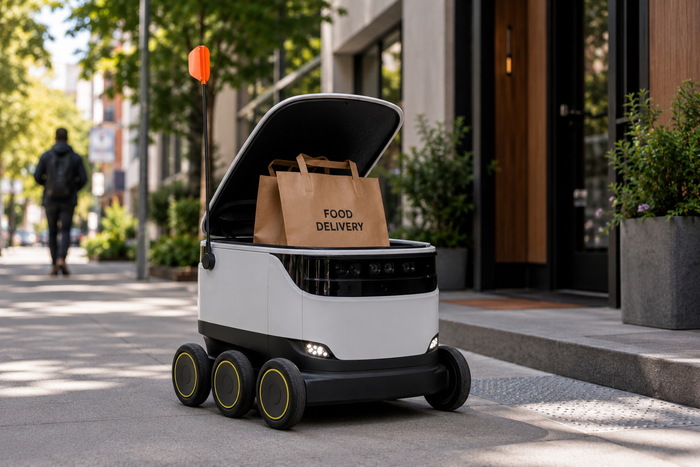
Food delivery robots have to operate in environments that are much less predictable than a lab or controlled test area. Sidewalk cracks, curbs, slopes, rain, dirt, pedestrians, changing temperatures, and repeated daily use can all affect how a robotic platform performs. These conditions influence nearly every part of the design, from the wheels and drivetrain to the electronics, sensors, enclosure, and food compartment.
A robot also needs to perform consistently as those conditions change throughout a route. Uneven pavement can increase vibration throughout the chassis, rain and dirt can interfere with sensors and electronics, and hills can increase motor and battery demand. At the same time, the robot needs to safely navigate around pedestrians while keeping the food protected throughout transportation.
Designing around these conditions early provides more opportunities to identify problems before deployment. Real-world performance should influence the mechanical, electrical, embedded, and system-level requirements from the beginning rather than being treated as something that can only be evaluated after a prototype is complete.
Designing for real-world operation
A delivery robot that performs well during prototype testing may behave differently once it’s deployed outdoors day after day. Controlled testing can demonstrate that the basic system works, but deployment introduces combinations of terrain, weather, payload, obstacles, and repeated use that can be difficult to completely reproduce indoors. These differences make the intended operating environment an important part of defining the product requirements.
Uneven pavement can increase vibration and loads throughout the chassis. Rain, dirt, and standing water can affect sensors, electronics, connectors, and moving components. Hills increase motor demand, heavier payloads affect braking and stability, and repeated impacts can loosen components or create wear over time.
The difference between controlled testing and real-world operation can be summarized through several common conditions:
- Surface conditions – Controlled testing may use predictable surfaces, while actual routes can include sidewalk joints, cracks, curbs, driveway transitions, and loose debris.
- Environmental exposure – Laboratory temperatures and conditions are relatively stable, while outdoor operation introduces rain, water, dirt, temperature changes, and direct sunlight.
- Obstacles – Test environments can use known obstacles, while deployed robots need to respond to pedestrians, vehicles, animals, objects, and unexpected route changes.
- Terrain – A controlled route may be relatively flat, while actual delivery routes can include slopes, uneven pavement, and changing surface conditions.
- Repeated operation – A prototype may complete individual test runs under engineering supervision, while a deployed robot may complete multiple routes every day.
Understanding these differences helps establish what needs to be evaluated throughout development. Rather than designing around an ideal route, the platform can be developed around the range of conditions it is reasonably expected to encounter.
Ruggedizing food delivery robots
Delivery robots can experience constant vibration and small impacts while traveling over sidewalks and other outdoor surfaces. Wheels, suspension components, structural joints, fasteners, electronics, batteries, and sensor mounts all need to withstand these loads over repeated delivery cycles. A component that performs correctly during an individual test may still develop problems after repeated exposure.
Environmental conditions create additional requirements. Electronics and batteries may need protection from water, dust, and debris, while enclosures still need to provide cooling, charging, maintenance, and access to internal components. Increasing protection in one area can therefore create tradeoffs elsewhere in the design.
Common ruggedization considerations include:
- Shock and vibration – Structural components, electronics, connectors, and sensor mounts need to tolerate repeated impacts and vibration during operation.
- Water and dust protection – Enclosures and interfaces should limit exposure to rain, dirt, debris, and other contaminants expected during outdoor use.
- Wheel and suspension design – Mobility components can help absorb uneven terrain and reduce loads transferred into the chassis and internal systems.
- Sensor protection – Cameras, LiDAR, and other sensors need physical and environmental protection without restricting their field of view or operation.
- Thermal management – Batteries, motors, processors, and electronics need to remain within appropriate operating temperatures as environmental and electrical loads change.
- Material selection – Exterior and structural materials need to tolerate outdoor exposure, repeated use, impacts, and expected environmental conditions.
These requirements should be considered together because ruggedization affects more than physical durability. Additional enclosure protection can affect cooling and accessibility, while stronger components can increase weight and energy demand. The objective is to provide appropriate protection without unnecessarily compromising mobility, serviceability, or performance.
Safety around pedestrians
Food delivery robots operate around people, which creates different safety considerations than robots operating inside controlled industrial environments. Pedestrians may approach from different directions, step unexpectedly into the robot’s path, or interact with the robot without understanding how it operates. Safety requirements therefore need to account for both autonomous behavior and the physical design of the platform.
The robot needs to detect obstacles, maintain appropriate speeds, stop when necessary, and respond predictably if a sensor or other system stops working. Mechanical features should also be reviewed for potential pinch points, sharp edges, exposed moving parts, or areas where someone could accidentally come into contact with the drivetrain. These considerations become increasingly important when the platform operates in areas with frequent pedestrian traffic.
Obstacle detection
Cameras, LiDAR, ultrasonic sensors, and other sensing technologies can help the robot identify pedestrians, vehicles, objects, and changes in its surroundings. Sensor location and coverage should be evaluated so that important areas around the robot are not left unmonitored. Placement also needs to consider how dirt, rain, physical damage, or other environmental conditions could affect sensor performance.
Sensor protection should not interfere with sensing itself. Covers, housings, mounting locations, and other protective features need to preserve the field of view and intended operation of the sensor while providing appropriate protection from the environment.
Stopping and speed control
Stopping distance changes depending on speed, payload, slope, and surface conditions. A fully loaded robot traveling downhill on wet pavement may require different braking performance than the same robot operating unloaded on a flat sidewalk. Speed and braking requirements should therefore be evaluated across representative operating conditions.
Operating speed also affects how much time the system has to detect and respond to an obstacle. Higher speeds may reduce delivery time, but they can place greater demands on sensing, control, drivetrain performance, and stopping distance. These factors should be evaluated together rather than independently.
Fault response
Sensor failures, communication loss, low battery conditions, motor problems, or computing faults should result in predictable behavior. A robot should not become unpredictable simply because one part of the system is no longer operating as expected. Fault conditions therefore need to be considered as part of the system design.
Depending on the condition, bringing the robot to a controlled stop may be preferable to allowing operation to continue with incomplete information. Development and testing can evaluate how the platform identifies faults, communicates its condition, and enters an appropriate state when normal operation cannot continue.
Designing for outdoor mobility
Wheel size, ground clearance, motor torque, suspension, vehicle width, and weight distribution all affect how well a delivery robot can travel over real surfaces. These characteristics influence whether the platform can cross sidewalk joints, handle slopes, maintain stability, and continue moving as payload and terrain change. Mobility should therefore be developed around representative routes rather than ideal surfaces.
A platform designed primarily around smooth pavement may struggle with driveway transitions, small curbs, loose debris, uneven sidewalks, or steep grades. These obstacles can increase loads on wheels and suspension components while also increasing motor demand and vibration throughout the chassis. A mobility problem can consequently become a structural, electrical, or power-management problem as well.
Payload also influences mobility. Adding food and beverages changes the total vehicle mass and may alter the center of gravity depending on where the storage compartment is positioned. Mobility testing should therefore evaluate representative payloads along with the surfaces and obstacles expected during actual delivery routes.
Protecting the food during delivery
The food compartment has to perform while the robot is accelerating, braking, turning, climbing slopes, and traveling over bumps. Containers can shift, drinks can spill, and different order sizes can change how the payload is distributed inside the robot. Protecting the order therefore involves both the compartment itself and how that compartment integrates with the rest of the platform.
The compartment may need to provide:
- Secure storage during movement – Internal features can help prevent containers from shifting during acceleration, braking, and turning.
- Protection from weather and contaminants – The compartment should separate the order from rain, dirt, debris, and other outdoor exposure.
- Insulation where required – Thermal requirements may influence compartment materials, wall thickness, seals, and packaging.
- Simple loading and unloading – Operators and customers should be able to access orders without unnecessary handling.
- Controlled customer access – Access features can help ensure the appropriate compartment or order is available at delivery.
- Easy cleaning – Interior surfaces should be accessible and appropriate for the expected cleaning procedure.
- Space for different order sizes – The compartment should accommodate the expected range of containers without unnecessarily increasing vehicle size.
The location and geometry of the compartment can also influence the robot’s center of gravity and weight distribution. A large or uneven payload positioned high in the platform may affect stability differently than the same mass positioned lower in the chassis. Payload protection and vehicle dynamics should therefore be considered together.
Power, payload, and range
Range depends on more than battery capacity. Robot weight, payload, terrain, motor efficiency, operating speed, onboard computing, stopping frequency, and environmental conditions can all affect energy consumption. The range measured under one set of conditions may therefore differ significantly from what the robot achieves on another route.
Increasing battery size may provide additional stored energy, but it also adds weight and requires additional packaging space. Larger payloads can increase delivery capacity while requiring more motor torque and energy. Additional sensors and processors may improve autonomous capability while creating greater electrical and thermal demands.
These tradeoffs should be evaluated together during development because improving one performance characteristic can affect several others.
| Design Variable | What Changes | Effect on the Robot |
|---|---|---|
| Larger Battery | Adds stored energy but also increases vehicle weight and packaging requirements. | Can extend operating time, but the added mass increases motor demand and may offset some of the expected range improvement. |
| Heavier Payload | Increases the load carried by the drivetrain, suspension, and braking system. | Requires more energy during acceleration and climbing while also affecting stopping distance and vehicle stability. |
| Steeper Terrain | Raises torque requirements and increases sustained motor load. | Reduces available range and can increase heat generation in the motors, motor controllers, and battery system. |
| Higher Operating Speed | Increases drivetrain demand and reduces the time available for sensing, braking, and obstacle response. | May shorten delivery times, but can increase energy use and place greater demands on safety and control systems. |
| More Sensors & Computing | Adds continuous electrical consumption and additional thermal load. | Can improve perception and autonomous capability while reducing the energy available for propulsion and extending cooling requirements. |
| Frequent Stops & Starts | Creates repeated acceleration and braking events throughout the route. | Can consume substantially more energy than steady travel, especially on routes with dense pedestrian traffic or frequent crossings. |
The table demonstrates why range cannot be designed around a battery specification alone. Route characteristics, payload, operating behavior, and computing requirements all influence the energy available for propulsion. Representative testing is needed to understand how these variables interact on the complete platform.
Testing for real-world conditions
Prototype testing should include conditions that represent how the robot will actually be used. Testing only on smooth indoor surfaces can establish basic functionality, but it provides limited information about how the platform responds to changing terrain, weather, payloads, and repeated operation. Real-world testing should build on controlled testing by progressively introducing these conditions.
Testing may include:
- Terrain and surface testing – Uneven pavement, sidewalk joints, inclines, declines, and other expected route conditions.
- Environmental testing – Wet surfaces, rain and water exposure, and representative hot or cold temperatures.
- Payload testing – Operation at different payload levels, including expected maximum loading conditions.
- Safety testing – Emergency stopping, obstacle response, and operation when sensing conditions change.
- Sensor testing – Obstruction or environmental exposure that may affect perception systems.
- Power testing – Low-battery operation and representative energy demand across different routes.
- Durability testing – Repeated delivery cycles that expose wheels, joints, mounts, enclosures, and other components to accumulated use.
Individual tests can identify specific problems, but repeated operation is also important. Components may survive one trip over rough pavement while loosening or wearing after hundreds of similar cycles. Testing representative conditions throughout development can reveal problems with durability, mobility, sensing, power consumption, or component placement before the design reaches production.
Food delivery robot development process
Developing a delivery robot requires several systems to progress together. Mobility, power, sensing, structural design, payload storage, environmental protection, and safety can all affect one another. A change to vehicle weight, for example, may influence range, braking, suspension requirements, and motor performance at the same time.
For this reason, development should move from defining the intended operating conditions through representative prototype and real-world testing before the platform is prepared for production.
- Requirements Definition – Establish range, payload, speed, terrain, environmental, service, and safety requirements.
- Concept Development – Evaluate vehicle layouts, mobility systems, sensors, payload locations, and component configurations.
- Prototype Development – Build functional prototypes for mobility, payload, electrical, sensing, and autonomous testing.
- Real-World Testing – Evaluate representative terrain, weather, payloads, stopping conditions, and repeated operation.
- Design Refinement – Address durability, mobility, sensing, power, or service issues identified during testing.
- Design for Manufacturing – Prepare components and assemblies for repeatable fabrication and production.
- Production Support – Support manufacturing, service requirements, component replacement, and future product improvements.
Each stage provides information that can influence the next. Problems identified during representative testing may require changes to the chassis, enclosure, drivetrain, electronics, or other systems before the design is ready for repeatable manufacturing. Maintaining that feedback throughout development can reduce the likelihood of carrying unresolved field-performance issues into production.
Designing for repeated use
A delivery robot may complete several trips every day, making repeated use an important design consideration. Wheels, bearings, motors, hinges, latches, seals, connectors, and other moving or exposed components will experience wear over time. Designing only around initial performance can overlook problems that appear after extended field operation.
Components that require regular inspection or replacement should be accessible for service. Modular assemblies can make it easier to replace wheels, sensors, batteries, motors, or electronics without taking apart large portions of the robot. Access panels, connectors, fasteners, and other service features should also be considered alongside environmental protection and structural requirements.
Serviceability becomes especially important when multiple robots are operating as part of a fleet. A repair that requires extensive disassembly can increase downtime and maintenance effort across every unit using the same design. Considering inspection, replacement, and maintenance during development can make repeated operation easier to support.
From prototype to deployment
Getting a food delivery robot to complete a route is only one part of development. The platform also needs to continue operating as surfaces change, components wear, weather conditions vary, battery state changes, and payloads differ from one delivery to the next. Reliable field operation depends on how well the complete system responds to that variation.
Ruggedization, pedestrian safety, mobility, power management, payload protection, testing, and serviceability should therefore be considered throughout development. These areas are connected, and changes intended to improve one can influence several others. Increasing battery capacity adds weight, additional protection can affect cooling, and changing payload capacity can influence stability and stopping distance.
Addressing these relationships early gives engineering teams more opportunities to find and correct problems before they become field failures. Representative testing can then provide feedback that continues to refine the design as it moves toward production and deployment.
Developing food delivery robotics with Synectic
Synectic Product Development supports robotic product development through mechanical engineering, electrical engineering, embedded systems, prototype development, testing, and Design for Manufacturing.
For food delivery robotics, these capabilities can support development from early system concepts through functional prototypes and production-ready designs. Testing and refining the platform around its expected operating conditions can help improve durability, safety, serviceability, and performance before larger-scale deployment.
Generate Better Concepts!
We’ve created a free workbook teaching you how to generate concepts that fit your product development needs.
Download your free workbook now!
About Synectic Product Development: Synectic Product Development is an ISO 13485-certified, full-scale product development company. Vertically integrated within the Mack Group, our capabilities allow us to take your design from concept to production. With over 40 years of experience in design, development, and manufacturing, we strive for ingenuity, cost-effectiveness, and aesthetics in our designs. Learn more about our product design services and see how we can help with your next project.
Recommended for you
Food delivery robots operate around people, which creates different safety considerations than robots operating inside controlled industrial environments.
The robot needs to detect obstacles, maintain appropriate speeds, stop when necessary, and respond safely if a sensor or other system stops working. Mechanical features should also be reviewed for potential pinch points, sharp edges, exposed moving parts, or areas where someone could accidentally come into contact with the drivetrain.